 Rockville MD
Rockville dispatch · Wheaton, MD
Emergency Plumber in Wheaton, MD: Leaks and Drains in 1950s Homes
Water is coming into the basement and you cannot tell whether it came from the street or from inside the house. The two need different calls and different people.
Wheaton is a 1950s suburb with newer buildings added later. The Census Bureau puts the median year built at 1960, and the 1950s alone account for a third of the 17,330 housing units.
Wheaton from Leesborough crossroads to postwar 1950s suburb
Wheaton grew from Leesborough, a small business district named in 1826 at the meeting of three roads. After the Second World War it expanded quickly, and the 1950s brought Cape Cod, ranch and split-level houses.
The housing counts show how thoroughly. About 72 percent of homes predate 1980, and 5,774 units, the largest single block, went up in the 1950s. Another 3,154 units, about 18 percent, were built in 2000 or later, and owners occupy about 65 percent of occupied homes.
- 1950s and 1960s houses: the original shut-offs and the drain connections at the lowest level are the usual first suspects
- 1970s and 1980s homes: a smaller group, often with the second round of water heater and fixture replacements already done
- Buildings since 2000: newer pipe and fittings, where the faults tend to be at connections and supports rather than wear
The 16-inch main on Georgia Avenue, July 2015
On July 1, 2015 a 16-inch main failed under Georgia Avenue. Patch reported that all southbound lanes were closed between Randolph Road and Henderson Avenue, several homes were flooded, and about 42 customers lost water. A WSSC official said the pipe was 68 years old.
It is a useful reminder of where the line runs. The street main is WSSC Water's, and the pipe inside your property is yours. When water appears, the first job is working out which side of that line it came from.
- Look at where the water enters. Wall, floor joint or window well points outside; a puddle under a fixture points to the house
- Check whether the street or a neighbour's yard is wet, and whether the neighbours have lost pressure
- Close the main shut-off if water is moving inside and you cannot see why
- Call WSSC Water if the street is the likely source, and call us if the water is in the walls or from a fixture
Downtown Wheaton's triangle of three roads and the Metro
Downtown Wheaton sits around the triangle formed by Veirs Mill Road, University Boulevard and Georgia Avenue. The Metro station, which opened on September 22, 1990, stands on Georgia Avenue at Reedie Drive.
Wheaton Regional Park, established in 1960 on 538 acres, lies nearby and includes Brookside Gardens. Callers often give us a landmark first and a street second, which is fine. We confirm the street address before anyone drives out.
Single-level houses and the one drain that carries everything
A ranch house puts every fixture on one level, so most of the drainage meets in a single line under the floor or in the basement ceiling. When that line slows, every fixture slows together.
That pattern separates a house-wide problem from a single blocked fixture. If the kitchen sink, shower and washing machine all drain slowly at once, clearing one trap will not help. The fault is further down, and a cable or camera gets there.
A split-level is different. The stacks run through two or three half-levels, and a gurgle in an upper bathroom can mean a blockage below the lowest connection.
Laundry, water heater and the lowest floor
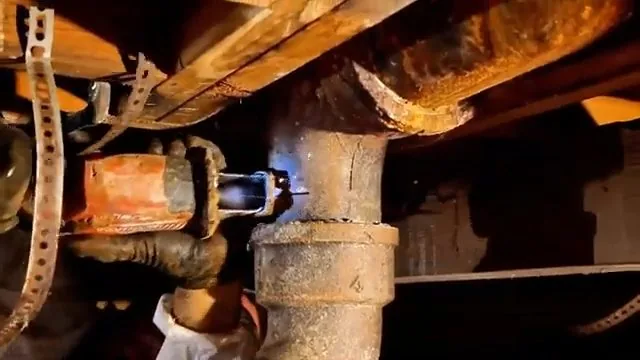
In many postwar houses the washing machine, the water heater and the floor drain share the lowest level. That puts the three most common sources of household water in one room, with the main drain running along the ceiling or under the slab beside them.
If your house has a basement or lower level, spend two minutes there now. Look for rust at the base of the heater, a crust of mineral at the washer hoses, and any damp ring on the floor around the drain. Finding any of them early is the difference between a small repair and a flooded floor.
- Rust or dampness at the foot of the water heater
- Washer hoses that bulge, weep or are more than a few years old
- A floor drain that smells or no longer takes water quickly
- A main shut-off that has never been turned and may not close
From Rockville to Wheaton: can we come?
Wheaton is about 6.1 miles from central Rockville. Its main ZIP code, 20902, is outside the list we dispatch to, so a visit turns on the address. Give us the street and cross street, and we will tell you honestly whether the address is within reach.
Wheaton plumbing questions
Is the pipe under the street mine or WSSC's?
WSSC Water looks after the mains in the street. We work on the pipe inside the property. If you are unsure where responsibility changes at your address, WSSC can tell you.
How do I tell a street problem from a house problem?
Water that enters through a wall or a floor joint, with a wet street or wet neighbours, points outside. Water under a fixture or running inside a wall, with the main valve closing it off, points to the house.
Why do all my drains slow down together?
They meet in one line. A blockage or sag in that shared run slows everything upstream of it. Clearing a single trap does not reach it, which is why the problem returns.
What if the water is in the basement but nothing looks wet upstairs?
Water collects at the lowest point, so the source can be anywhere above it. We check the appliances and fixtures on the floors above first, then the lines in the ceiling, then the outside wall.
Does a 1950s house always need repiping?
No. We look at what is in the walls and what is failing before saying anything about replacing it. Age alone is not the test.
What this leads to
Water that is already in the house is a drying job as well as a plumbing one, and water damage cleanup covers that part. A pipe that has split inside a wall is on the pipe repair page.
Slow drains in older single-level houses are usually a matter for a drain cleaning visit, and a stubborn one for a look at the main line.
Water inside, and the street is wet too?
Tell us where the water is entering and whether the neighbours have the same trouble. That tells us which pipe to look at first.