 Rockville MD
Rockville, MD · Leak Detection
Water Leak Detection in Rockville, MD: Find the Source Before Anything Gets Opened Up
Most leak calls we take are not someone looking at water. They are someone looking at a bill, a stain, or a meter that will not settle.
That is the useful part of this work. A leak you can see has already told you where it is. The ones worth paying someone to find are the ones with no obvious source, and those get narrowed down in a specific order.
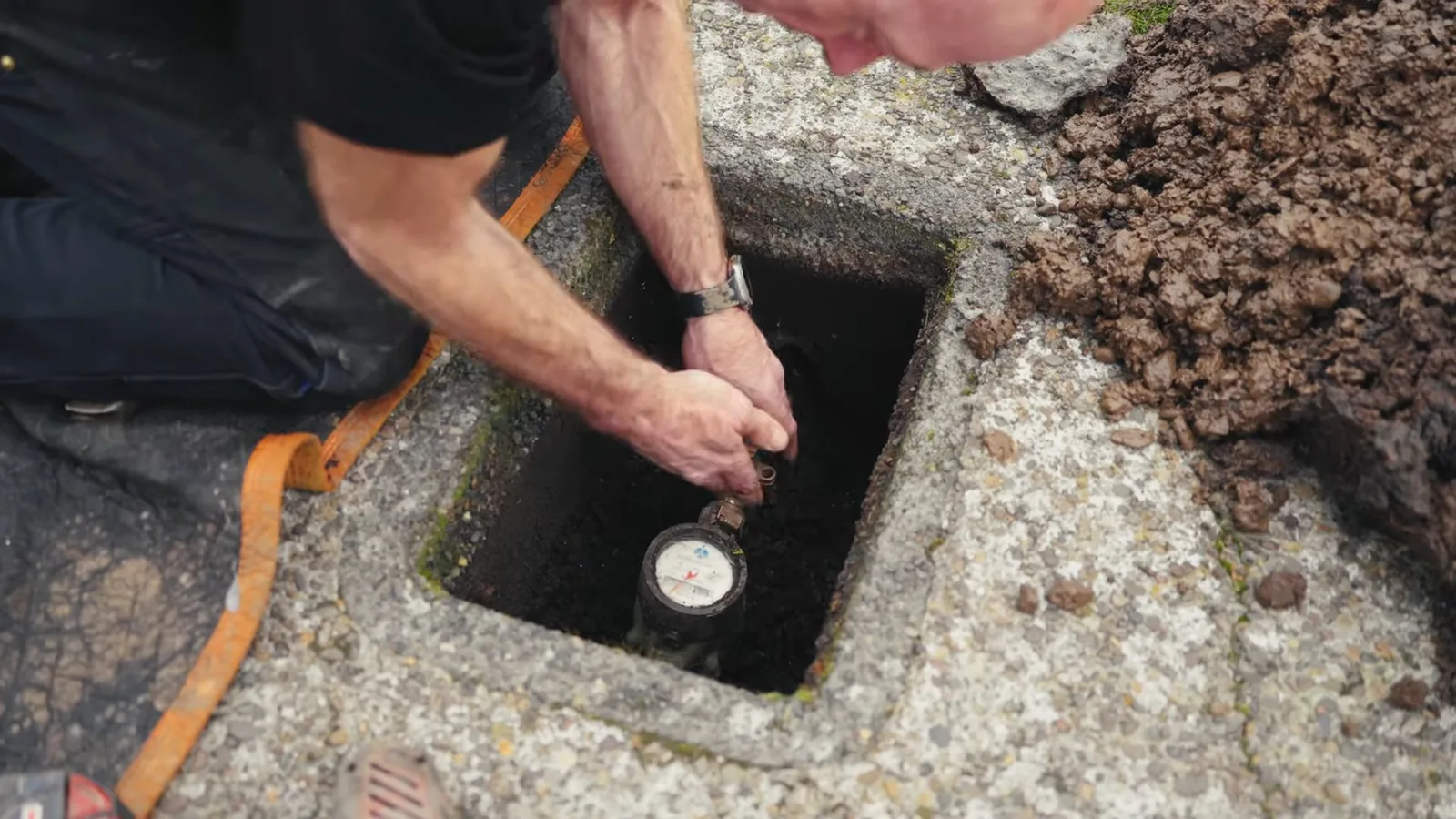
The 20-minute meter test you can run before anyone visits
Before any equipment comes out of the van, there is a test you can run yourself in about twenty minutes. It separates a real leak from a high bill with an ordinary explanation, and it costs nothing.
- Turn off every tap, appliance and ice maker, and ask the household to leave the water alone.
- Find your meter and note the reading, including the small sweep hand or the leak indicator if it has one.
- Wait twenty minutes with nothing running.
- Read it again. Any movement at all means water is going somewhere.
- Now close the main shut-off valve inside the house and repeat. If it still moves, the leak is between the meter and that valve, which is usually the buried service line.
That last step is the one most people skip, and it is the one that matters most. It splits the problem into inside or outside, and those are two very different jobs with two very different owners.
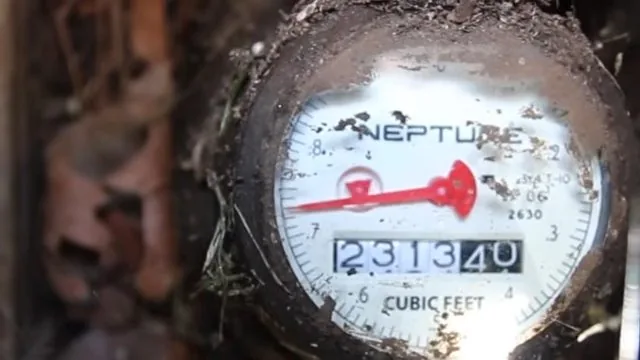
Which utility bills you changes who owns the leak
Rockville is unusual, and it matters here more than on most pages. About 70 percent of the city, some 13,500 accounts and around 54,000 people, drinks water from the city's own Potomac plant, which has run since 1958. WSSC Water supplies the rest.
So two houses on the same street can have different utilities, different billing, and a different office to ring about a meter. Before you chase a high bill, check which name is on it.
Permitting does not split the same way. Whichever utility treats your water, WSSC Water issues the permits and does the inspections for plumbing and gas fitting in both of its counties. That catches people out when a located leak turns into a repair that needs a permit.
| If your water comes from | High bill or meter question | Permits and inspection |
|---|---|---|
| City of Rockville | City utility billing, city meter staff | Still WSSC Water |
| WSSC Water | WSSC customer service | WSSC Water |
Signs that show up before you see water
By the time there is water on a floor, the leak has usually been running a while. These are the earlier signals, and they are worth acting on while the job is still small.
- A bill that climbed with no change in how the household uses water, especially across two cycles
- A meter or leak indicator that creeps with everything turned off
- Pressure that dropped at every tap rather than at one fixture
- A patch of lawn that stays green, soft, or thaws first in cold weather
- The sound of water running when nothing is on, often clearest at night
- A musty smell in a cupboard, a basement corner, or against an outside wall
- Paint lifting, a skirting board swelling, or tile grout darkening in a line
- A hot water bill rising on its own, which points at the hot side specifically
None of these proves a leak by itself. Together they tell us where to start listening, which is most of what a detection visit is.
What acoustic leak detection equipment can and cannot tell you
Leak detection gets sold as though a device points at the answer. It is closer to narrowing a search area until breaking into one spot is a reasonable bet rather than a guess.
Acoustic equipment listens for the noise a pressurised leak makes through pipe, soil and floor covering. It compares that between two points to work out where it is loudest. Thermal imaging finds temperature differences, which is why it is better on hot lines and on wet building material than on a cold line in cold ground. A pressure test tells us whether a section is holding at all, which is often the simplest way to prove the problem is not where you thought.
What none of it does is see through a slab or a wall. On a quiet pressurised line with running water nearby, or a leak under deep fill, the honest answer is a wider area and a staged approach rather than a confident mark on the floor.
When a leak is an emergency and when it can wait
Most detection visits are planned. Some leaks are not. If water is running that you cannot stop, or it is close to electrics, treat it as an emergency and act before you worry about finding the source.
- Water that keeps running after you close the nearest fixture valve
- A ceiling that is sagging, bulging or dripping steadily
- Water reaching a socket, a fuse board or a light fitting
- A meter that turns fast with every tap and appliance off
Close the main shut-off valve first, then call. Closing it stops the supply to the leak, and the diagnosis can happen afterwards. A bill that crept up slowly, a damp cupboard or a patch of lawn that stays soft is not urgent and can wait for a booked visit.
Ceiling stains, wall damp and working out where it started
Water does not drop straight down. It runs along a joist, a pipe, or the back of plasterboard until something stops it, so the stain is almost never under the leak.
On a ceiling stain we work upwards. Fixtures above it first, then the pipes serving them, then the waste connections. A supply leak runs whether anyone is home or not. A waste leak only runs when something is used, which is why a stain that grows after every shower points somewhere very different from one that grows overnight.
Moisture meters map how far the wet area extends behind the surface. That decides how much needs opening up. That usually ends up smaller than people fear, and knowing the edge of it before cutting is the point of measuring at all.
Basements, crawl spaces, and water that is not plumbing
This is a basement market, and basement water is the call where being honest costs us work and saves you money.
Not all of it is plumbing. Water that appears after heavy rain, enters low on a wall, or arrives at the floor to wall joint is usually groundwater or surface water, and no amount of pipe work fixes it. Rockville gets around 40 inches of rain a year. The dominant local soils are weathered schist residuum rather than anything expansive, so this is a drainage and grading question rather than a soil movement one.
Plumbing in a basement tends to announce itself differently. Look for a leak that runs in dry weather, a damp patch that does not match the rain, or staining partway up a wall where a pipe runs. A drip you can trace to a joint overhead belongs in the same group. We test for those, and if it turns out to be groundwater we say so rather than selling you a repair.
- Runs in dry weather, so rain is not the trigger: usually plumbing
- Only after heavy rain, at the floor to wall joint: usually groundwater or surface water
- Clean water with no smell, running continuously: usually a supply line
- Appears only when a fixture upstairs is used: usually a waste connection
Outside: the yard line, the meter box and the irrigation system
Outside leaks are the ones the meter test points to most often, and the service line between the meter and the house is the usual answer.
Those lines are buried below the 30 inch frost depth used here, so they are not generally freezing in place. They fail at fittings, at points of mechanical damage, and sometimes from age. Worth knowing: WSSC banned lead as a service line material in 1954. It also runs a pipe type programme covering lead, unknown and galvanized lines that require replacement. If your line is on that programme, that changes the conversation before any digging, so we check it rather than quoting blind.
Irrigation is its own common culprit, because a zone valve that weeps runs on a schedule and then stops, which makes it look intermittent. The test is simple enough: isolate the irrigation supply at its own valve and repeat the meter reading. If the movement stops, the leak is in the irrigation system rather than the house.
- Fittings on the service line between the meter and the house
- Joints inside the meter box, or on the stop tap beside it
- A zone valve that weeps, or a drip line that has split
- An outdoor tap that has failed below the surface
Copper pinholes against the city's own water data
Pinhole leaks in copper are real, and they get blamed on water quality more often than the local numbers support.
Rockville's own 2025 report puts lead at the 90th percentile below 1 part per billion, against a 15 ppb action level, with no sites exceeding it. Copper at the 90th percentile was 0.100 ppm against a 1.3 ppm action level, from 2024 sampling. A corrosion inhibitor is added during treatment. That is not the profile of aggressive water eating through pipe walls across a city.
When we do find a pinhole, it is usually local rather than systemic: a spot of mechanical damage, a section of pipe that sat against something abrasive, a high velocity run, or a dissimilar metal joint. That matters. A local cause means a local repair, and a systemic one would mean a much larger conversation. We work out which before recommending anything beyond the pipe in front of us.
Leaks we locate but do not repair ourselves
Two things turn up in leak searches that are not a plumber's work, and pretending otherwise wastes a visit.
A roof or gutter leak is a roofing job. It can look identical from inside, which is exactly why it is worth ruling out. A stain on a top floor ceiling, water appearing only during or shortly after rain, and nothing moving on the meter all point at the roof rather than at a pipe. We will tell you when that is what the evidence says, and you want a roofer rather than us.
Pool and spa leaks are a specialist trade with their own equipment. We can help with the plumbing that feeds a pool, such as the supply line, the fill valve and the connections inside a plant room. We can also run a meter test that tells you whether the loss is on the house side at all. Finding a leak in a pool shell, liner or buried circulation loop is work for a pool leak specialist.
Commercial and multi-unit leaks: tracing the unit, riser and meter
Commercial leak work is a different problem, and it is well represented in the calls we take. The leak is rarely the hard part. Working out which unit, which riser, and which meter it sits behind is.
In a multi-unit building the water usually shows up somewhere other than where it started, often two floors down. Access also depends on someone who is not the person reporting it. So the sequence changes: isolate what can be isolated, read the building meter against the unit meters where they exist, and narrow by riser before opening anything.
For managed property we write down what the search found, and the record covers four things.
- The tests run and the readings taken
- What was isolated and what was ruled out
- Which riser, unit or common part the water was traced to
- Photographs of the opened area before and after
That record is usually what the managing agent or the insurer needs rather than a verbal account. If the leak sits in common parts, knowing that early changes who pays.
High bills, damp basements and gas smells
My water bill doubled and I cannot find anything wrong. Where do I start?
Run the meter test on this page before paying anyone. It takes twenty minutes and shows whether water is actually moving.
Then check which utility bills you, because Rockville is split between the city's own supply and WSSC Water. If the meter is still, call your utility about the billing.
Can you tell exactly where the leak is before digging or cutting?
Usually we can narrow it to a small enough area that opening one spot is a reasonable decision rather than a guess.
On a quiet leak under a slab or deep fill, the honest answer is a search area rather than a mark on the floor.
I can smell gas. Is that the same call?
No, so treat it differently. If the smell is strong, leave the building and call the gas utility from outside before you call a plumber.
Gas testing and repair needs a master gasfitter licence. That work is on our gas testing and repair.
The water in my basement only comes in when it rains. Is that a plumbing leak?
Probably not. Water that tracks the weather, arrives at the joint between floor and wall, and does not move the meter is usually groundwater or surface water.
We will test for plumbing causes and say plainly if that is not what this is. A grading, gutter or drainage fix is the answer then.
Do you charge for detection separately from the repair?
Detection is its own piece of work, because it takes time and equipment whether or not a repair follows. We tell you what it costs before starting.
The repair is quoted on its own, and you can take the detection result and get the repair priced elsewhere.
Where detection ends and repair begins
This page is the finding step. Once we know what is leaking and where, the repair usually belongs to a different page. A split or failed pipe goes to pipe repair, a line running under a poured floor goes to slab leak work. A tap, stop or waste fitting goes to repairing a tap or stop valve.
If you can smell gas, that is a different call and a different licence. Gas testing and repair is on the gas line page, and it is work for a master gasfitter rather than something to fold into a water leak visit.
Where water has already soaked into the structure, drying is its own job and runs alongside the repair rather than after it. That is structural drying.
Covered ZIPs: 20850, 20851, 20852, 20853 · Full service area
Bill gone up, or a damp patch you cannot explain?
Looking for leak detection services Rockville, MD? Tell us what changed and roughly when. A lot of these get narrowed down on the phone before anyone drives out.